Saturday, September 11, 2010

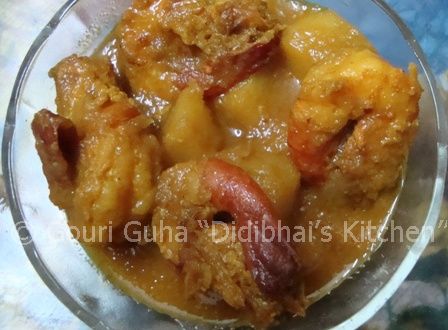
Chingri Macher Malai Curry with a difference


The chingris (prawns) were swimming in the huge earthen tub Balai had placed close to him. Balai, the machwala, our very own machwala (the fishmonger) who kept his stock of fresh prawns and bancha (live) magur for Baba. The big and small prawns moved about in the water and children, who went to the fish market, stood with backs bent at 45 degrees to see them...fear and excitement moving together in the euphoric trolley of childishness.

When the chingri was carried home in the cotton jhola...Ma stitched the jholas from the used and somewhat faded floral skirts and frocks of her little girls. Her little girls...never protested ...once the old ones were cut and stitched into user friendly items...there was a look beyond ...for new ones...and then...

The wait for the curry to be served would be like waiting for years. Ma would give instructions and Thakur (the cook) would follow obediently...she loved supervising. With chingri in the kitchen, it could be Chigrir jhol, Chingri Kosha, Chingri Bhapa, Chingrir Malai Curry, Chingri cooked with lots of onion and capsicum and tomato sauce, Chingrir boda. Thinking about all this my mouth salivates.

...and my recipe waits to be written down...my Chingrir Malai Curry with a difference...


                                Prawns - shelled and de-veined

Prawns – ½ Kg. shell and de-vein, wash properly, sprinkle some haldi powder and salt. Set aside to marinade.

Make a paste of 2 onions, 2-3 garlic cloves and about an inch length of ginger.

Coconut milk– ½ cup

Haldi, red chilli powder, a pinch of sugar and salt to taste, tej patta and whole garam masala.

And of course cooking oil.

Place the kadhai/wok on the burning stove. Add 1 cup of water. As soon as the water starts getting hot, add the marinaded prawns , cover and let it cook for 2-3 minutes. By now the water is completely dry, add 2 tsp of cooking oil and stir the prawns for another couple of minutes. Now keep it aside.

When I have a good stock of prawns, I marinade with salt and haldi powder, cook them in boiling water for a short time, about 3-4 minutes, put them out in a bowl to cool. This is then kept in the fridge for later use...can be added instantly for any dish as it is already cooked. I feel the flavour and taste remains much stronger than when it is fried.

In the kadhai pour some oil, quantity check is yours. Once it is hot add 2 tej patta (bay leaves), whole garam masala of cinnamon (dalchini) 2 sticks, cardamom (elaichi) 4 and cloves (laung) 4...beaten in mortar and pestle to break up roughly...and sauté. When the aroma of the spices start spreading add the onion, ginger, garlic paste and sauté for 3-4 minutes over medium flame.

Then put in 1 tsp haldi powder, ½ tsp red chilli powder, and sauté again.

Next add salt and sugar and cook till the spices show sign of separating from the oil.

Add the coconut milk and some water and let this gravy cook over high flame for some more time.

Now add the prawns and watch out for your preferred thickness of the gravy.

Serve with rice, for that’s better.

As I had mentioned in the title, this curry is cooked with a difference. It was the sudden arrival of guests during the lunch hour which made me think of increasing the quantity to serve this curry to everyone without any complaint. I boiled 2 big potatoes, removed the skin and made small cues.

When the gravy showed signs of thickening, added the prawns and cubed potatoes. Cooked for another couple of minutes before transferring into the serving bowl.


Everyone relished the taste of the prawns...compliments for the cook... and it made no difference.
 
In a malai curry we don’t add potatoes, but you can in a situation like this...makes no difference. After all “Necessity is the mother of invention” isn’t it?

Monday, September 6, 2010

Mur(d)i Ghonto (Bengali dish) – Curried Fish Head


This is not an everyday recipe. A Bengali household can relish Macher jhol everyday with gorom gorom (hot) bhaat (plain rice). And when the whole Rui (rohu) mach (fish) is brought home, carefully the Ginni (lady of the house) cleans the fish, separates the daily quota and puts the fish head in the deep freezer along with the remaining packets. On a Friday night, before sleep engulfs her, she chalks out her menu for the next day. She thinks of cooking mur(d)i-ghanto for the Saturday lunch, when everyone in the house is together for a sumptuous meal with some finger-licking dishes. She takes utmost care to cook her mur(d)i-ghanto and happy with the compliments that come her way.

The ‘she’ in me is no way less interested. Last Saturday I cooked mur(d)i-ghanto.

Speaking of mur(d)i ghanto, the ‘d’ sound has its own effect in it. Not a tongue twister but the tongue helps in bringing the two sounds together...like the Kingfisher Ad...

Cookinh Mur(d)i Ghanto is easy. For this dish we need:

Fish head – 1 big Rohu head will do. Clean it properly, wash, rub it with some haldi (turmeric) powder and salt.

1 tomato, washed and cut into tiny pieces.

In the meantime peel two big potatoes, wash and dice them.

2 onions, 4-5 fat garlic cloves, 1 inch long ginger, all go together into making a paste.

Kick start the cooking process by placing the kadhai/wok on the stove. Pour oil enough to fry the fish head. Once done, this goes into waiting.

Pour out some oil from the kadhai into a small bowl for later use. There should be about 2 tbsp oil remaining in the kadhai.

Now tip in whole garam masala – cinnamon 1 inch stick, cloves 4-5, cardamom 4-5 – don’t beat them hard but a simple crush in mortar and pestle so that they are slightly broken. Tip them in the kadhai and soon the aroma of the grand Indian spices will start spreading all around. Add 2-3 bay leaves.

Add the onion, ginger, garlic paste and cook for 3-4 minutes.

Put in the tomatoes pieces. Soon the tomatoes will start breaking up and become mushy.

After having cooked for 6-7 minutes add the cubed potatoes. Cook till the oil separates from the masala.

In the meantime take 2 tbsp of raw rice and roast them in another pan. Once the rice starts hopping and popping around in the pan, pour them into the cooking kadhai.

Now break the fried fish head into smaller pieces, tip into the kadhai and stir cook for 2 minutes.

Add water (sufficient for the potatoes to cook), cover with a lid and let the curry cook over high flame.


Once the water dries up Mur(d)i Ghanto is ready to be served.


Savour this dish with plain rice or roti.
And let me know. 

Thursday, September 2, 2010

Awards from Madhu

I feel happy and excited to receive these awards from Madhu. Been quite some time she asked me to collect them from her blogspot, though late, I’ve collected them. Thanks and welcome for sharing and thinking about me.

Thanks again Madhu for these lovely awards.

Rule on receiving The Versatile Award says that I have to say 7 things about me. Bear with me and read on...

1. Can’t do without my first cup of tea in the morning.

2. Love to travel.

3. Reading and writing is my passion and cooking too.

4. Though I have few potted plants, love to speak to them every day and look after them with much care.

5. I am sincere in what I do.

6. I do get angry very soon but the heat comes down very quickly.

7. Like to watch movies. Love games and sports.


I would like to share these awards with Deepa, Kamalika, Babli, Suja, Ushnishda and all my blogger friends. Feel free to collect them from here.

Wednesday, September 1, 2010

Lau-er Tarkari – Simply simple -- Lauki/Bottle Gourd Curry


I've been irregular here... my posts stand witness. But my kitchen gives out every day the aroma of the different spices, spreading all around the house...the sensitive nostril can pick up what’s cooking there. It’s so hot and humid these days and how I want a cooling effect in my kitchen...why wipe the sweat from time to time with the loose end of my sari...

...cool cool kitchen, a weird thought creeps into my mind...

A typical Indian kitchen, shelves lined up with bottles...some full, some half-filled and even some empty ones waiting to be washed, dried and then filled up. Cooking utensils of different shapes and sizes...a must.

The sound of the morning whistle blowing...not from a train engine or even a child’s toy train... the pressure cooker cooking and singing or more correctly whistling as the dal...a common everyday dish for many Indian homes...boiling and cooking...waiting for the tardka...the very next step that follows soon.

... the whoosh and cha(n)k-choo(n)k (the ‘n’ gives the nasal note) noise (a Bengali expression) coming when cooking is on. Lots of oil and ghee and masala going into cooking and at the end the kitchen sink is filled with sticky utensils to be rubbed and scrubbed and washed clean for the next use.

...and who has to do all this...dependence, on someone who comes to help...

Back to my kitchen for the Lau Tarkari. Very simple and no puzzle to solve.

To serve this dish for 4 people you need to take Lau/Lauki not one but two medium ones. Wash it before peeling off the skin. Never wash the lau/lauki after cutting into pieces. Cut the lau/lauki into small pieces. Don’t judge the quantity before cooking for once the cooking is over the quantity reduces to a little more than half of what it was in its uncooked form.

Place a kadhai/wok or any cooking vessel on heat. Sprinkle about 1 ½ tbsp of cooking oil in it.

When the smoke starts coming up add 2 green chillies slit in the middle. To this add 1 ½ tsp of kalo jeera/kalonji/nigella seeds.

After you hear that little noise that it gives out, add the lau/lauki pieces to it. Stir and cover and again stir and cover, repeat this, and cook for 3-4 minutes on high flame.

Now set the stove on medium flame and add haldi powder about ½ tsp, very small quantity of red chilli powder, ¼ tsp, salt and sugar to taste, sugar can be optional but a little quantity will balance the taste.

Stir, cover and now cook on low flame. The lau will release water which will help in the cooking.

After cooking on low heat for 10-12 minutes, cook  on high flame. Open the cover and stir-cook for another 5-7 minutes till the water dries up completely.


Serve with hot plain rice and dal. I like it with gorom (hot) parathas and Luchi/Puris.
This is a simple and perfect niramish curry.

Note: You can pressure cook the lau/lauki after adding all the ingredients. 3-4 whistles and after opening the lid, cook till the curry is dry, make sure there is no water remaining. Serve it hot.

Wednesday, August 11, 2010

Suji (Semolina) Upma

I was in bed for days, down with fever. Even after the fever left me for good, I was not the usual self that I am. I tried to spend some time on my internet, but was unable to sit with it for a long time. So I was left with little reading, posting fewer comments and no posts from my end...really boring lying down all the time.

After feeling better I made Suji Upma and how I relished it, for by now I was fed up with the food I ate. And this upma tasted heavenly, maybe because I didn’t get to eat my normal food for so many days.

I looked for the suji/semolina container which had been misplaced in my absence from the kitchen. Measured a cup of it and dry roasted it till it started to get the pinkish touch. Kept it aside. Took an onion, a big one, and cut it. The onion pieces sat on a plate while I took the next step.

Placed the kadhai on the burning stove and poured 2 tbsp of groundnut refined oil. Once it was hot added some curry leaves and then put in 1 tbsp of chana dal, 1tsp of mustard seeds and once the
spluttering started added the onion pieces and gave it a stir. When the onion started to lose its firmness added 2 cups of water and let it come to a boil. Then came the salt and soon added the roasted suji and kept on stirring. Before the water dried up totally, added 1 tbsp of ghee and my Upma was ready.

I gobbled up the simple dish like someone who had not eaten for days. And then had a cup of tea...felt so good.